
We should spare a thought for the widow Alison Marshall in this next story, who tragically lost not only her husband John McCulloch Snr in the 1877 Blantyre Pit Disaster, but also her 16-year-old son, John. Though there is another young man, Thomas McCulloch who also lost his life in this pit accident, but he was not the son of Alison and John. The following events took a bit of untangling as there are many errors duplicated on Ancestry websites.
This story starts in Central Scotland in Stirlingshire when John McCulloch was born on 1st May 1833 at Denny to parents Thomas McCulloch (b1811) and Anne Dawson (b1812). His parents had married on 29th June 1828 in Denny, Stirlingshire and John was the 3rd child of 5. His father, Thomas was a coal miner and when new collieries opened up in Airdrie, Lanarkshire in the 1840’s, the family moved in pursuit of new employment. During that decade when John became a teenager, his brothers James and Alexander were born in Airdrie. Around 1847, when John was 14, he left school to join his father as a coal miner, as was the custom for many boys in this early Victorian era.
By 1853, at the age of 20, John McCulloch had met sweetheart Alison Marshall and the couple married near her home at Slamannan, Stirlingshire on 12th November 1853. This was also close to the area where John had spent his childhood, so it was clearly a natural choice for the couple to place down roots in the immediate years after they married. John was a 20-year-old coal miner and Alison (b1835) was 2 years younger, at 18 years old when she wed. For the young couple, life would be challenging and deeply shaped by the harsh realities of the mining industry, social conditions, and cultural norms of the time.
The couple lived in a mining Parish at Bothkennar, Stirlingshire in a “row” close to the colliery where John worked. Basic amenities were minimal. There would be no indoor plumbing; water was fetched from communal wells, and sanitation was primitive, often involving shared outdoor privies. As a coal miner, John’s job was physically demanding, dangerous, and poorly paid. He worked long hours, typically six days a week, often starting early in the morning and working until late in the evening and may have had little time to spend with his new wife. Alison would have been responsible for managing the household, which included cooking, cleaning and washing clothes by hand. Nine months later on 7th August 1854, a first child, a son Thomas was born. Alison now had the additional duties of being a mother and indeed, John and Alison would go on their lives to produce 10 children in 18 years which followed. Sadly, at least 3 of them wouldn’t make it to 16 years old. Bothkennar Parish no longer exists but the old church at Bothkennar Kirk still does.

Mining residences were often polluted from coal dust and waste. Poor ventilation and damp conditions in homes led to respiratory problems. Combined with inadequate sanitation, the spreading of diseases was apparent. Just 4 years after son John McCulloch was born in 1857, in 1861 the little boy sadly died. Another child Anne born in 1865 would pass away age 6 in 1871. This must have been absolutely heartbreaking and perhaps itself contributed to the idea of moving away for a fresh start to escape grief. Indeed, to honour those two children, they named further children with the same names. Another boy to be called John was born in 1861 and another Ann in 1871, both births in the same year as children had died. This may seem strange to a modern reader but was quite common in previous centuries.
In 1871, with the death of a second child, the family after living at Bothkennar for 18 years moved to Lanarkshire, choosing to live in the small, pretty village of Bothwell for a couple of years. This was likely due to John’s brothers living there and of course the opportunities which presented themselves for mining employment. However, before long, the news was that Coal had been discovered in Blantyre and that Coalmaster Dixons were opening up new pits at High Blantyre with more attractive wages and plenty of long-term work. A logical step for the family was to move the short distance to High Blantyre, indeed to a house almost adjacent to the new pits themselves. It was to be a decision marked by fate.
With a bit of research, Thomas McCulloch is found in the 1875 Blantyre Valuation roll though the surname spelling was MacCulloch. Knowing that son Alexander was born in Bothwell in May 1873, this is a good indication the family moved to High Blantyre sometime in the latter half of 1873 or 1874.

Renting a small house from Archibald McClelland for £9 a year, the modest house was located on the Hamilton to East Kilbride Turnpike Road at Auchinraith, on what is now more commonly known as Main Street, High Blantyre. Today it has the name ‘Meadow Cottage’. The stone build semi-detached cottage on the south side of the street had a view from the back over towards the High Blantyre pits, with the McCulloch’s only having a short walk each day to and from work. By 1875, the son John McCulloch Junior was 14 and would have left school in High Blantyre to join his father at Dixon’s Collieries as a coal miner.

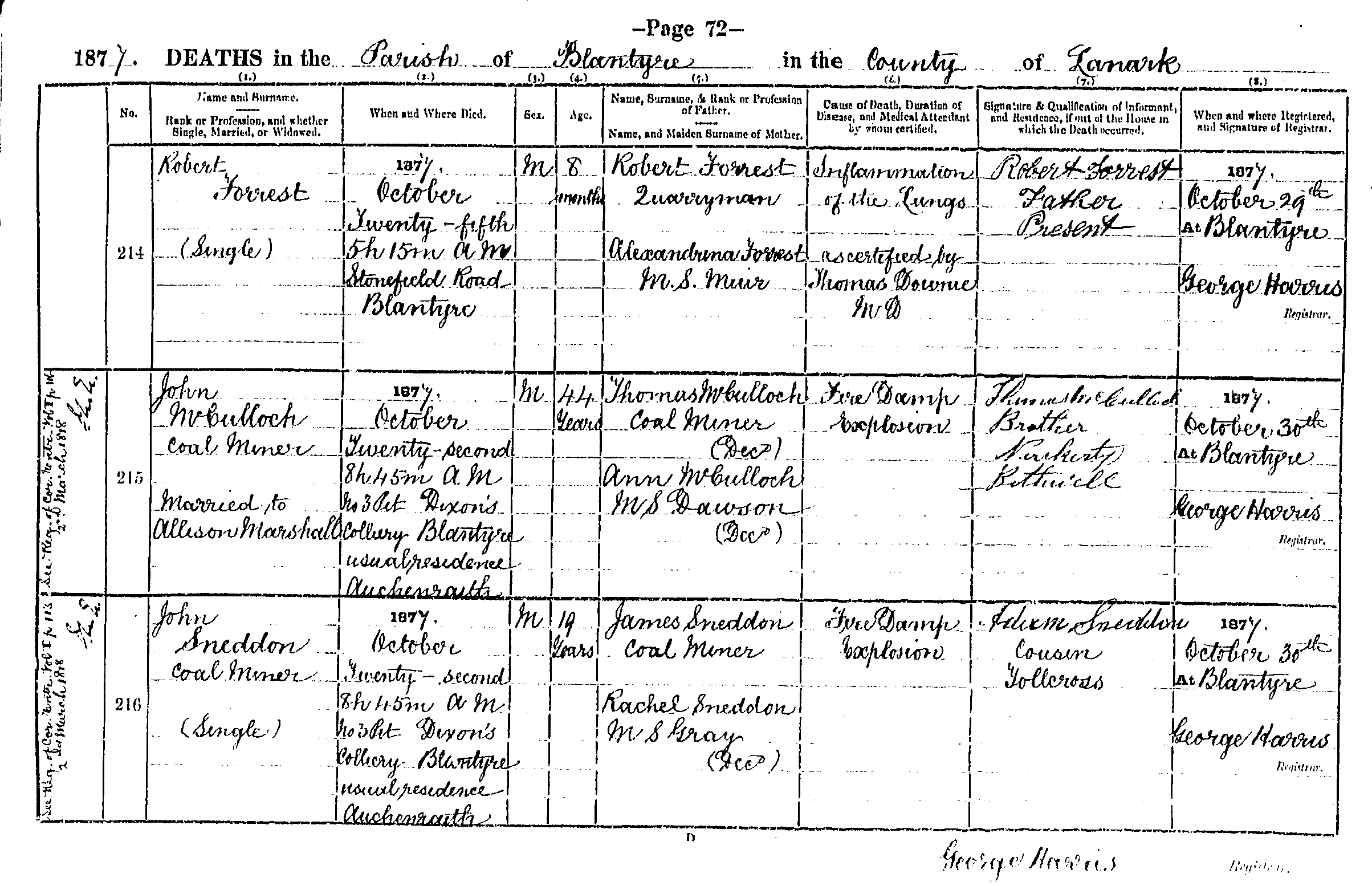
At 8.45am on the morning of 22nd October 1877, an explosion at Dixon’s Pit 2 and 3 took the lives of 216 individuals, including John McCulloch (age 44) and his son John McCulloch (age 16). With so much debris falling down Pit shaft 3, it became difficult to reach the area where these miners were entombed and frantic efforts followed in the coming week or two to clear the area and make access.
During the next week, Alison McCulloch and her family would have faced a tremendous anguish and there is a certainty that any hope would have quickly faded as the days went on. It’s known that Rev Wright visited the McCulloch family that week to offer comfort.
The body of John McCulloch Senior was brought up from Pit 3 on 30th October 1877, just over a week after the accident. Given the time which had elapsed, he was quickly interred the same day at High Blantyre Cemetery. His funeral took place, whilst his son’s body remained unfound and below ground, which must have been unbearable for the family. His brother signed the death certificate. Many of the victims of this disaster were buried in mass graves when two long trenches were dug, but unusually not the McCullochs. The location of John is known at Section D, Lair 247 of High Blantyre Cemetery, though the gravestone erected by Alison Marshall is broken in half, it’s still in good, readable condition. The new memorial stones located at the Obelisk, unveiled in 2022 also mentions him and his son by name.
The Glasgow Herald wrote that day, “Early this morning three bodies were recovered — the only ones “drawn” till night — and they were identified as those of John McCulloch, 44, miner, Auchinraith; Arch. McKillop, 13, drawer, Burnbank; and John McKelvie, 19, miner, Parkhead.” The body lay in the morgue that day of John McCulloch, 44, collier, Auchenraith. Identified by his wife, Alice Marshall or McCulloch. Body was not much decomposed, and easily recognisable.”

His son John McCulloch Jnr (16) would be brought up from the pit and buried alongside him a few days later on 3rd November 1877.
Alison Marshall, now a widow, despite losing a husband and son is known still to be in Blantyre in the early 1880’s but had moved by 1881 and was getting by taking in several lodgers. Her profession is ‘shirtmaker’ in the 1881 census but known to have moved to Summerlee around this time. It was a bad decision. She suffered another terrible tragedy a year later when sixth son Alexander was killed in an accident at Summerlee Colliery in 1882.
Annie her daughter looked after Alison in her older years. Annie died in 1914 aged only 42 and Alison a year later in 1915 aged 79. They are buried in High Blantyre together with the rest of the family.
On Wed 26th June 2024, the great great granddaughter of John McCulloch, Julie McCulloch visited Blantyre from her home in Indianapolis, USA. I was pleased to meet up with Julie on my day off and show her around Blantyre, including the scene of the Disaster, the places John lived and where her relatives are buried. Here’s some of my photos from earlier in June 24.


Thanks Julie. It was a pleasure to meet you and Glenda. Have a wonderful holiday.
I wish i could show the depth of my gratitude for all the time, effort and energy you put into uncovering the story of my family. I hope you know how much it means to me. It’s a beautiful story. Well done. ❤️