

During the 1870’s coal mining was a fledgling and growing business in Blantyre. Exploratory work to determine the new coal seams often uncovered other interesting minerals that could be commercially mined. This included iron and lime. Dotted all over the High Blantyre area of Crossbasket and Auchentibber are small crater like holes a few metres in diameter that were once lime pits. Lime was excavated and sold on for it’s use in mortars and cements and the ironore, useful for producing iron girders, (well preceding steel, and at the peak of the industrial age, used extensively for building trains, railway tracks, bridges and ships). The function of the sink holes were to provide either access or ventilation shafts down a considerable depth to a more substantial mine. They also offered an alternative method of egress usually vertical. Today at ground level, these dangerous pits are often partially filled in or overgrown with the murky water appearing white due to the lime content.
Through social media, we encountered tales that during the 1960’s and 1970’s rumours were abound in the village that these pits were the craters of “small bombs” dropped from World War 2 German planes trying to hit the grand house at Crossbasket, but this is absolutely not true.
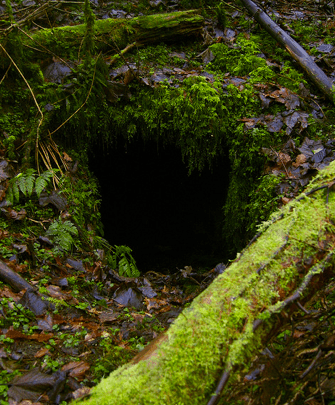
The mine opens up into a series of dark, flooded corridors, reinforced with stone and presumably back then, with wood too. There are small inserts in the stone, likely for oil lamps.


These rank corridors far below the fields above, lead into small stone lined rooms, each with a function for mine operation. Abandoned in the early 1900’s when the minerals were exhausted, the mine is now derelict, easily missed and unseen by passing ramblers on the paths above.
Lime pit mining was a dangerous profession. On Wednesday 18th May 1877, a Mr Patrick Kenney (27 years) came to Blantyre seeking employment. With some mining experience, he soon found a job at the established Crossbasket mine. On his very first day on Friday 20th May, this unfortunate individual was subjected to a nasty fate. Only 4 hours into his employment, a quantity of several tonnes of blaes and ash suddenly collapsed into the mine from above falling directly on top of him. The force and quantity of the heavy material instantly killed him. Local press reported that his wife and child took up residence in Blantyre only the day before. They were requested that evening to collect Patrick’s body from the High Blantyre mine. I read this sad newspaper story prior to actually finding and seeing the mine for myself. Watching my dog bark ferociously into the darkness for no apparent reason but too frightened to go over the entrance, it was a place that I was glad to make a hasty retreat from.