


Their visit led to the building of New Lanark, with four mills and housing for workers. The mills operated very profitably. Later they became famous because of the social experiments conducted there by Robert Owen, who was Dale’s son in law. They closed in 1986. New Lanark has been designated a World Heritage site by UNESCO and attracts hundreds of thousands of visitors each year.
Dale was involved in a number of other mills.
Blantyre Mills were established in the 1780’s by David Dale and James Monteith. The mills continued in operation until 1904. Now, all that remains is a single housing block. This was the birthplace of David Livingstone and the building now contains the David Livingstone Centre and some reconstructed mill workers accomodation.
Catrine was a small village in Ayreshire until Dale and Claude Alexander built a cotton mill there in 1787[see the separate post on Catrine].
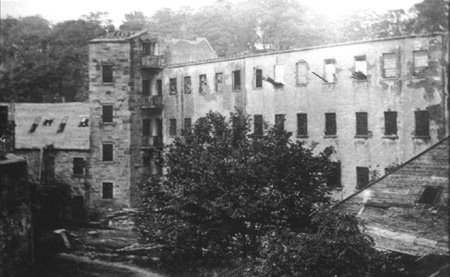
Spinningdale was a small mill built by Dale, in partnership with George Dempster, in around 1790. It was intended to relieve local unemployment but the highlanders employed in the mill kept going off to work on lambing, harvesting and cutting peat. When the mill burnt down in 1806 it was not rebuilt.
Stanley Mills had been built in 1784 by Richard Arkwright to harness the power of the Tay. Dale only became involved later and supposedly lost a lot of the money he invested in the mill. Stanley Mills continued in in business until 1989, latterly as a jute mill. The buildings are now being restored
Highlanders – At the time that Dale was building his mills people were very reluctant to work in factories and a lot of Dale’s workers were highlanders who had been dispossessed by the The Clearances.
At New Lanark and Catrine reservoirs were built to store water so that the mills could continue in operation even in summer. Long tunnels were cut through rock at New Lanark and Stanley to carry water to the mills.
Social Conditions – The conditions in some cotton mills were appalling. Many employed child labour and treated the children very badly. There were high death rates. Dale cared about his workers and provided good accommodation and decent working conditions. New Lanark had particularly good housing, the first working class school in Scotland and The Institute for the Formation of Character. The people of Blantyre were thankful for Dale. The tenements in High Blantyre main street right at the junction with Broompark Road, still have the name “Dales” carved into the sandstone about 12 foot up.
Dale’s mills started the industrial revolution in Scotland. They also introduced the factory system and changed the ways in which people lived and worked.