

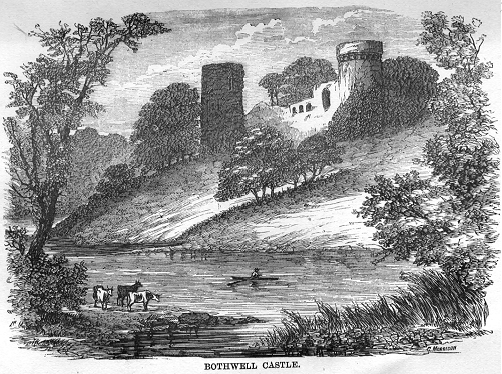
A Victorian account of walking alongside Blantyre Priory. A tourist’s tale preserved in history and a beautiful old print of Bothwell Castle from Blantyre Priory grounds.
“Stately foxglove fair to see,”
(digitalis purpurea)nodding its towering crest of crimson bells, the broad-leaved helleborine (epipactis latifolia),with its curiously plaited foliage, and those most beautiful of our indigenous geraniums, the wood crane’s-bill (geranium sylvaticum) and dusky crane’s-bill (geranium phoeum) growing in great abundance; while the pink-flowered woundwort, the purple-tufted vetch, the yellow bed-straw, and a bright profusion of kindred blooms are thickly strewn wherever an opening in the leafy canopy overhead permits an entrance to the solar beams. The time of the singing of birds is nearly past, but occasionally the joyous chant of the wood-warbler, or the merry trill of the wren resounds through the green gloamin’, and drowns for a time the hum of countless insects which seem to be enjoying their little hour of life with music and dance in the genial summer air.
After a pleasant ramble through the tangled mazes of the wood, we arrive at the Priory, which is situated on a precipitous rock rising to a considerable height above the Clyde. The building, which is of a fine-grained red sandstone, has apparently been at one period of great extent. It is now, however, a complete wreck. A portion of the walls and gables, with several windows and a fireplace, on the verge of the precipice, with a kind of vaulted chamber now threatening to fall in, are all that has been spared by the hand of Time. There are several trees growing among the ruins, and the walls are partly covered with the mournful ivy,
“Still freshly springing,
Where pride and pomp have passed away,
To mossy tomb and turret grey—
Like friendship clinging.”